
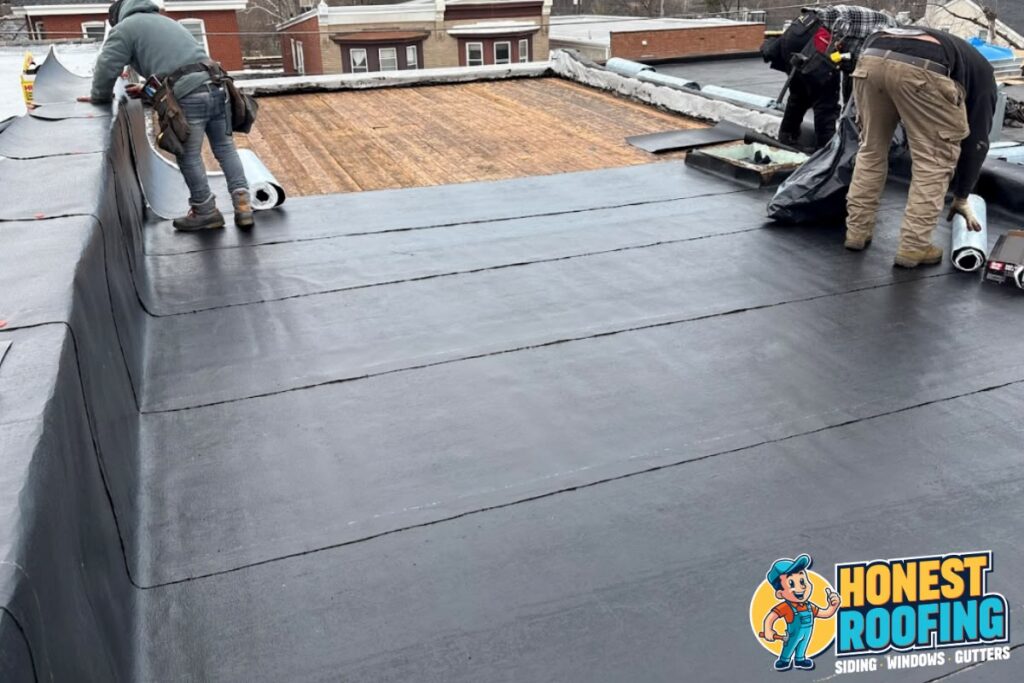
Honest Roofing is a licensed roofing contractor serving Pennsylvania homeowners and commercial property owners with low slope roofing, EPDM roofing, TPO roofing, and flat roof repair and replacement services across the state and the most common question the team fields from Pennsylvania property owners in 2026 is a version of the same thing: my flat roof is leaking, or I have a low slope addition and I do not know what kind of roofing system I actually have. Low slope roofing requires a fundamentally different approach than pitched shingle roofing, and the choice between EPDM and TPO, the two most common membrane systems installed on low slope roofs in Pennsylvania, has real cost and performance implications that most contractor websites address in a single vague paragraph.
This article gives you the full picture. You noticed a water stain on the ceiling of the garage or the addition, or you received a quote that mentioned EPDM replacement and did not know what that meant, or you looked up at your flat roof after a heavy rain and saw standing water that was not draining. By the end of this article you will know what low slope roofing is, what the real difference between EPDM and TPO looks like for Pennsylvania conditions and budgets, and exactly how Honest Roofing approaches a flat roof assessment and installation.
In this article:
What is low slope roofing and why does it need a different system than standard pitched shingles?
Low slope roofing refers to roof surfaces with a pitch of 3:12 or less meaning the roof rises 3 inches or less for every 12 horizontal inches and these surfaces cannot shed water effectively the way a pitched shingle roof does. Because water drains slowly or sits on a low slope surface, low slope roofing requires a continuous waterproof membrane system rather than overlapping shingles. The two most common membrane systems installed on low slope roofs in Pennsylvania are EPDM (a synthetic rubber membrane) and TPO (a thermoplastic membrane).
What pitch qualifies as low slope and why does it matter for Pennsylvania homes?
A 3:12 pitch is the commonly cited threshold between low slope and pitched roofing in the construction industry. Below that threshold, asphalt shingles cannot drain water fast enough to prevent moisture infiltration between courses and on a low slope surface, water moves slowly enough that capillary action can pull it behind overlapping courses, creating leak pathways that are not visible from outside the home. Many Pennsylvania properties have a main pitched section with a lower-pitch garage, addition, or wraparound porch section that falls below the 3:12 threshold without the homeowner being aware. If your addition leaked first, if your garage ceiling has the water stain and the main house does not, this is why. The section of roof above it is a different system from the main house or it should be.
Why shingles fail on low slope surfaces and what a membrane system does differently
Asphalt shingles work by overlapping. Water that enters at a course joint runs down and over the next course rather than behind it, but only when water velocity is sufficient to prevent backflow. On low slope surfaces, that velocity is not sufficient and capillary action wins. A membrane system eliminates field seams on the flat surface entirely. EPDM and TPO are both single-ply systems installed as a continuous sheet across the flat surface, with seams at the perimeter and at penetrations rather than across the full field. There is no overlap to fail because there is no overlap. The membrane is the waterproof layer full stop.
Ponding water on Pennsylvania flat roofs what it means and when it is a problem
Ponding water is defined as water that remains on a flat or low slope roof surface 48 hours after a rain event. Pennsylvania receives significant precipitation and goes through repeated freeze-thaw cycles that make ponding water a meaningful concern. Ice forming in ponded water expands, stresses the membrane, and can compromise seams and perimeter flashings over time. Standing water that does not drain also masks the exact location of a leak by creating secondary water pathways across the membrane surface. Honest Roofing evaluates drainage function as a standard part of any low slope roofing assessment because a correctly installed membrane on a poorly draining deck will still fail prematurely.
Can you put shingles on a low slope roof in Pennsylvania?
Most shingle manufacturers do not warrant their products below 4:12 pitch, and some define a low slope application as low as 2:12 with specific high-performance underlayment requirements. In practice, the failure rate of shingles installed on surfaces below 3:12 in Pennsylvania conditions is high enough that shingle roofing is not the appropriate recommendation for those surfaces. A membrane system is the warranted and appropriate solution for low slope applications, and Honest Roofing recommends based on the measured pitch not on what was previously installed. The National Roofing Contractors Association defines low slope roofing systems and application standards for practitioners across the industry, and their guidance on membrane system selection is the professional reference point for this category.
What is the difference between EPDM and TPO roofing and which performs better in Pennsylvania conditions?
EPDM (ethylene propylene diene monomer) is a synthetic rubber membrane that has been the standard for low slope roofing in Pennsylvania for decades, flexible, durable, and well-suited to Pennsylvania freeze-thaw cycles, with a typical installed lifespan of 20 to 30 years. TPO (thermoplastic polyolefin) is a newer single-ply membrane that reflects solar heat more effectively than EPDM, installs faster with heat-welded seams, and typically costs in a similar range per square foot but has a shorter performance track record in Pennsylvania climate conditions. EPDM vs TPO cost in Pennsylvania in 2026 typically ranges from $5.00 to $8.00 per square foot installed for EPDM and $5.50 to $8.50 per square foot installed for TPO, with the gap closing significantly when project size and membrane thickness are held constant.
EPDM roofing in Pennsylvania: what it is, how it performs, and when it is the right choice
EPDM is a rubber membrane most commonly installed in black, with white reflective versions available. It has been installed on Pennsylvania low slope roofs since the 1960s and carries the longest single-ply performance track record in the state. The material remains flexible at low temperatures without cracking, which makes it well-suited to Pennsylvania winters where freeze-thaw cycles stress roofing systems repeatedly through the season. EPDM seams are adhesive-bonded rather than heat-welded, which means seam integrity depends on adhesive quality and application conditions. The most common EPDM failure point is adhesive seam separation, not membrane degradation of the field itself. EPDM is the preferred system for low slope residential applications in Pennsylvania where longevity and freeze-thaw performance are the primary concerns.
TPO roofing in Pennsylvania: what it is, how it performs, and when it is the right choice
TPO is a thermoplastic membrane typically white or light grey that reflects solar heat more effectively than black EPDM, making it a meaningful energy performance choice for commercial flat roofs in Pennsylvania with significant cooling loads. TPO seams are heat-welded, which produces a mechanically stronger seam than adhesive bonding when the weld is correctly executed. TPO has been widely installed since the 1990s but has a shorter Pennsylvania track record than EPDM. Early TPO formulations had documented premature degradation issues, and while current products have improved substantially, the 20 to 30 year lifespan range that EPDM has demonstrated in Pennsylvania is not yet confirmed by equivalent TPO field history. TPO is the preferred system for commercial low slope applications in Pennsylvania where energy reflectivity or welded seam strength is the priority.
EPDM vs TPO cost in Pennsylvania in 2026: what drives the price difference
The per-square-foot gap between EPDM and TPO is often under $1.00 when project size and membrane thickness are held constant. The cost variables that matter more than the material choice are: membrane thickness (45 mil vs 60 mil vs 90 mil, with thicker membranes commanding meaningfully higher pricing), project size (larger projects reduce per-square-foot cost for both systems), deck condition (deteriorated decking adds scope to any membrane replacement project), and drainage work required. A quote that specifies the membrane thickness, the insulation specification if applicable, and the per-square-foot contingency for deck replacement is a complete document. A quote that shows only the membrane type and a total price is not.
How long does EPDM roofing last in Pennsylvania?
Properly installed 60 mil EPDM on a Pennsylvania low slope roof typically performs for 20 to 30 years. The primary lifespan variables are membrane thickness, installation quality, ponding water management, and annual maintenance. Thicker membrane (90 mil) extends expected lifespan toward the upper end of that range. Annual seam inspection and prompt attention to any adhesive separation are the most effective maintenance investments for reaching the full lifespan on an EPDM system. Silicone roof coatings can extend the service life of an EPDM membrane that is structurally sound but showing surface weathering, at a significantly lower cost than full replacement.
How does Honest Roofing approach low slope roofing assessment and installation in Pennsylvania?
Honest Roofing assesses low slope roofing in Pennsylvania with an on-site evaluation that measures pitch, identifies the existing membrane system, evaluates deck condition and drainage, and documents any active leak pathways before recommending a repair or replacement scope. For Pennsylvania properties with both a pitched shingle section and a low slope flat section, Honest Roofing can assess and address both in a single project scope because the two systems often interact at their transition points, and a leak in a flat section frequently originates at the flashing between the membrane and the adjacent shingle roof.
Here is what the process looks like in practice. The first call covers the address, the description of the flat or low slope section, and any visible symptoms ponding, interior staining, or visible membrane damage. The on-site evaluation measures the pitch of the affected section, identifies the existing membrane type, assesses seam condition across the field and at penetrations, evaluates deck integrity where accessible, and maps drainage function relative to the drain or scupper locations. The written assessment document identifies the issue, states the membrane recommendation with rationale, scopes the repair or replacement with line-item pricing, and includes a per-square contingency for deck replacement if applicable.
For commercial property owners managing flat-roof buildings in Pennsylvania, the assessment process follows the same sequence with additional attention to drainage volume requirements, insulation specifications, and access constraints relevant to occupied commercial properties.
Can a low slope roof be repaired instead of replaced?
Localised repair is viable when the membrane is in good overall condition with isolated seam failures or penetration flashing issues a section of adhesive seam that has separated, a pipe boot that has cracked, or a drain collar that needs resealing. When the membrane has generalised adhesion loss, multiple seam failures across the field, or surface degradation beyond the perimeter zone, replacement is typically more cost-effective than repeated repair over a one to three year period.
Silicone roof coatings are a third option for EPDM membranes with remaining structural integrity and sound seams the coating restores waterproofing performance at a significantly lower cost than full replacement when the substrate qualifies. Honest Roofing advises on the repair vs coating vs replacement decision at the assessment visit, with the written assessment document providing the rationale for the recommendation.
Low Slope Roofing Problems Start With the Wrong System or the Wrong Assessment Honest Roofing Starts With Neither
You now understand what low slope roofing is, why standard shingles fail on surfaces below 3:12 pitch, what the real EPDM vs TPO trade-offs are in Pennsylvania conditions and cost, and what the Honest Roofing assessment process produces before any scope is committed.
Request a low slope roofing assessment from Honest Roofing on-site evaluation, written assessment with membrane recommendation and cost breakdown, and honest advice on whether repair, coating, or replacement is the right call for your specific roof.