
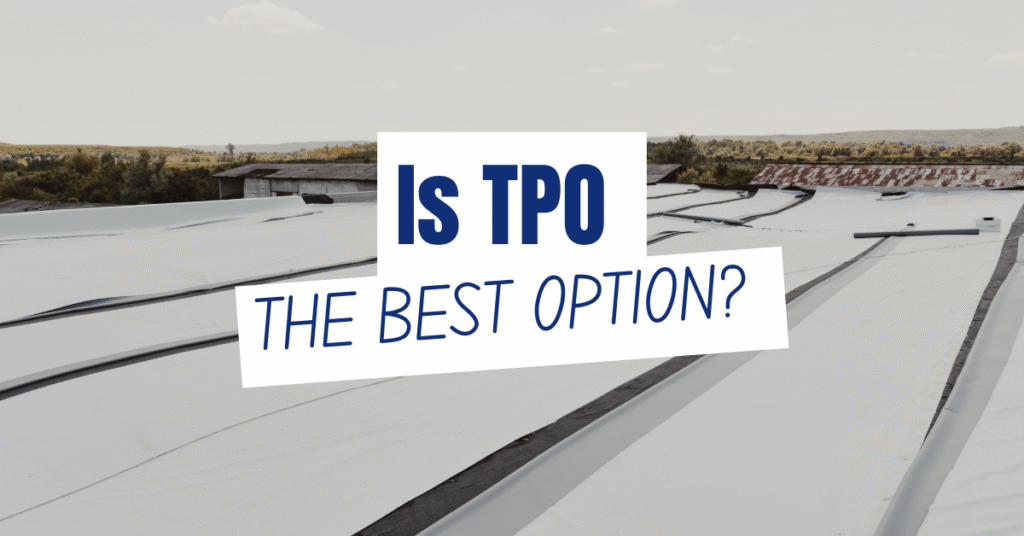
TPO commands 40% of the commercial flat roofing market for good reason. It is energy efficient with competitive pricing, and strong overall performance.
However, does being the most popular automatically mean it’s the best?
In this guide, we’re cutting through manufacturer marketing and contractor sales pitches to give you honest, building-specific guidance on when TPO is the right choice for warehouses and retail centers—and when it’s not.
Understanding TPO: What Makes It So Popular
TPO (Thermoplastic Polyolefin) has exploded in popularity since the early 2000s, and understanding why helps you evaluate whether those advantages matter for YOUR building.
What TPO actually is: TPO membranes consist of three layers: a TPO polymer base, a polyester-reinforced scrim center, and a thermoplastic top layer, available in 45, 60, and 80-mil thicknesses.
The white surface is TPO’s signature feature, delivering exceptional solar reflectance.
TPO’s core advantages for commercial buildings:
Energy efficiency is TPO’s superpower. The white surface achieves solar reflectance values of 0.79-0.87, exceeding Energy Star requirements.
For warehouses and retail centers with significant air conditioning loads, this translates to cooling cost reductions of 15-30%.
A 30,000 square foot retail building spending $25,000 annually on cooling might save $4,000-$7,500 each year with TPO versus black EPDM.
Unlike EPDM’s adhesive or tape seams, TPO’s thermoplastic nature allows installers to literally melt seams together, creating watertight integrity that lasts decades.
Seam strength on PVC and TPO heat-welded joints test at over 90% of membrane strength.
Installation efficiency matters for large commercial projects.
TPO comes in wide rolls up to 12 feet, meaning fewer seams and faster installation on expansive warehouse roofs. This reduces labor costs and minimizes business disruption during installation.
Moderate pricing positions TPO between budget EPDM and premium PVC. For cost-conscious warehouse and retail operators seeking quality without premium pricing, TPO hits a sweet spot.
When TPO Is the Right Choice for Your Building
Here’s when TPO is genuinely the best option for warehouses and retail centers.
Climate-controlled facilities in moderate to warm climates:
If your building maintains interior temperatures year-round and cooling costs represent a significant operational expense, TPO’s energy efficiency pays for itself quickly.
Pennsylvania’s southeastern regions (Chester County, Montgomery County, Philadelphia area) experience hot, humid summers where TPO’s reflectivity shines.
Buildings in these areas typically see stronger ROI from TPO than facilities in northern PA’s colder climate zones.
Large, simple roof designs: Warehouses with expansive, uncomplicated roof surfaces maximize TPO’s installation efficiency. Fewer penetrations mean faster installation and lower labor costs on large warehouse roofs.
A 50,000 square foot warehouse with minimal HVAC units and simple drainage is perfect TPO territory.
Energy efficiency priorities: Buildings pursuing LEED certification or operating under strict sustainability mandates benefit from TPO’s documented energy performance. The reflectivity data and cool roof certifications make compliance straightforward.
New construction or full replacement scenarios: TPO’s performance advantages show best on clean installations with proper substrate preparation. If you’re building new or doing complete tear-off replacement, TPO’s full potential can be realized.
When Alternatives Outperform TPO
TPO isn’t always the answer. Here are scenarios where EPDM, PVC, or other systems deliver better value.
Non-climate-controlled warehouses: If your warehouse isn’t air-conditioned, TPO’s energy efficiency advantage evaporates.
You’re paying for reflectivity you don’t need.
EPDM might be a better fit if you’re on a tight budget and don’t need high reflectivity.
A storage facility or distribution center with minimal climate control saves money with EPDM’s lower cost without sacrificing performance.
Extremely cold climates or northern Pennsylvania: Pennsylvania’s northern regions experience brutal winters with extended sub-freezing temperatures. While modern TPO handles cold better than early formulations, EPDM’s superior cold-weather flexibility gives it an edge. In snowy regions like Central Pennsylvania, EPDM is ideal—its black surface absorbs heat and helps melt snow, reducing ice buildup.
Buildings with chemical exposure: PVC would be the best choice if your roof is exposed to chemicals or grease, making it ideal for food processing, restaurants, and high-end retail with kitchen operations. TPO resists many chemicals but can’t match PVC’s comprehensive chemical resistance.
Maximum longevity priorities: EPDM has installations from the 1970s still performing today, demonstrating proven 40+ year potential. If you’re planning 30+ year ownership and want maximum lifespan over energy efficiency, EPDM’s track record beats TPO’s shorter history.
Extremely harsh Pennsylvania weather exposure: EPDM’s elasticity absorbs hail impact without fracturing, making it superior for areas prone to severe thunderstorms and large hail. While TPO handles weather well, EPDM’s forgiving nature under extreme impact gives it an advantage.
Budget-constrained projects: If upfront cost is your primary driver and energy savings aren’t a priority, EPDM delivers the lowest installed cost.
Making Your Decision: Key Questions to Ask
Answer these questions to determine if TPO is right for your warehouse or retail center:
1. Is your building climate-controlled year-round?
- Yes, with significant cooling loads → TPO advantage
- No, or minimal climate control → EPDM likely better value
2. What are your annual energy costs?
- High cooling costs ($15,000+) → TPO ROI strong
- Low energy costs or heating-dominated → EPDM preferred
3. What’s your ownership timeline?
- Long-term (20+ years) → Consider EPDM’s proven longevity
- Medium-term (10-20 years) → TPO excellent fit
- Short-term (under 10 years) → Either works, budget may decide
4. What’s your roof traffic pattern?
- Regular access for HVAC maintenance → TPO’s puncture resistance helps
- Minimal traffic → EPDM’s lower cost appeals
5. Any chemical or grease exposure?
- Yes, from operations → Consider PVC
- No → TPO or EPDM both fine
6. What’s your climate zone?
- Warm or moderate → TPO performs excellently
- Very cold with harsh winters → EPDM’s cold-weather advantage matters
7. What’s your budget reality?
- Moderate, seeking value → TPO delivers well
- Tight, cost-critical → EPDM saves upfront
- Flexible, wanting premium → PVC for maximum performance
Conclusion
So is TPO the best flat roof for warehouses and retail centers? The honest answer is that it depends on your specific building, location, and operational needs.
For climate-controlled warehouses and retail centers in Pennsylvania’s moderate to warm regions, TPO often delivers the best combination of energy efficiency, durability, and value. The cooling cost savings alone can justify the investment, and modern TPO formulations provide 20-25 years of reliable service.
For non-climate-controlled warehouses, facilities in harsh northern climates, or budget-constrained projects, EPDM’s lower cost and proven 30+ year track record frequently make it the smarter choice. You’re not paying for energy efficiency you won’t use, and you’re getting time-tested durability.
For retail centers with food service, chemical exposure, or premium performance requirements, PVC’s superior resistance and longevity justify the higher investment despite being more expensive than TPO.
The key is matching the roofing system to your building’s actual requirements rather than following trends or accepting the first contractor recommendation. TPO is an excellent roofing system—but only when it’s the right system for YOUR warehouse or retail center.
Need expert guidance on the best roofing system for your Pennsylvania warehouse or retail center?
We install TPO, EPDM, and PVC roofing systems throughout Chester County, Montgomery County, and all of southeastern Pennsylvania and New Jersey. Our experienced commercial roofing team will assess your building’s specific needs, evaluate energy costs, consider your timeline and budget, and provide honest recommendations about which system delivers optimal value for YOUR situation.
Schedule your free commercial roofing consultation today! Call us at 484-369-0040 or contact us online.
Let’s determine whether TPO, EPDM, PVC, or another system is the smartest investment for your warehouse or retail property.
We’re here to help you make informed decisions that protect your building and your bottom line for decades to come!