
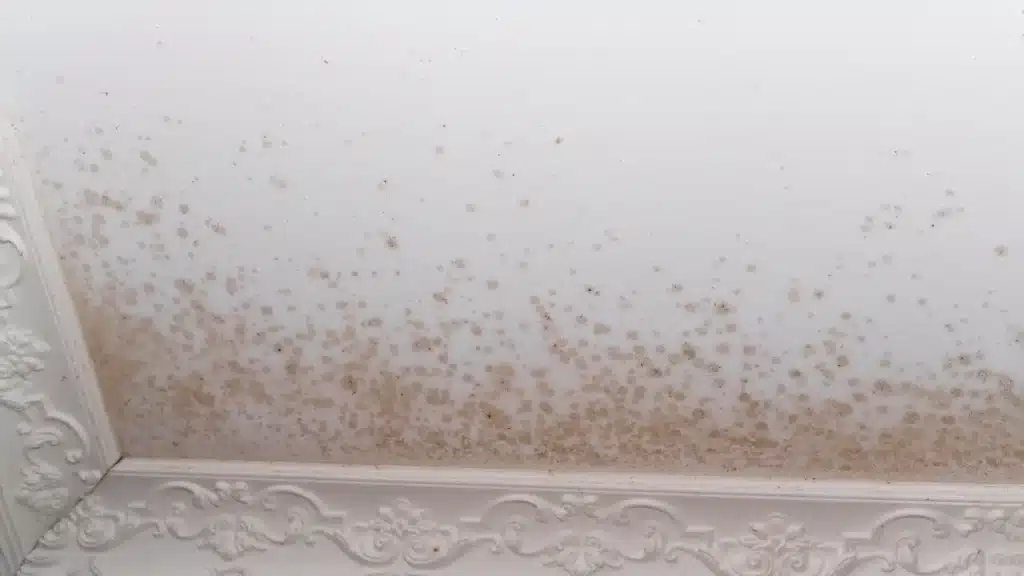
Honest Roofing provides roof leak repair across Pennsylvania for residential and commercial properties, including emergency response for active water intrusion. The thing that makes roof leaks so frustrating to track down is that water almost never enters directly above where it appears. It travels along rafters, decking, and insulation before it finds somewhere to drop through, which means the stain on your ceiling is usually several feet, and occasionally fifteen or twenty feet, from the actual hole.
If you have water coming through a ceiling right now, call Honest Roofing. Do not wait for the rain to stop.
You have probably already been up in the attic with a torch and found nothing obvious. That is normal. It is not a failure of your inspection it is how water behaves.
Table of Contents
What should you do right now if your roof is leaking?
Move furniture and electronics away from the affected area, place a bucket under any active drip, lay plastic sheeting or towels to protect flooring, photograph the damage before cleaning anything up, and if the ceiling is bulging or holding water, pierce it with a screwdriver at the lowest point to drain it into a container in a controlled way. A bulging ceiling left alone can collapse all at once, which is considerably worse than a controlled release.
Clear the area first
Furniture, electronics, rugs, anything that absorbs. Obvious, but people freeze and watch the drip instead.
Contain the drip
Bucket underneath, plastic sheeting or towels under that to catch spread and splash. One small trick most people do not know: tie a length of string from the drip point down into the bucket. The water runs down the string instead of splashing out of it.
Drain a bulging ceiling in a controlled way
This one feels wrong and it is the most important step on the list.
A ceiling holding water will eventually fail, and it fails all at once. Pierce it at the lowest point of the bulge with a screwdriver, container underneath, and let the water out in a controlled way. You end up with a small hole to patch instead of a collapsed section of ceiling across your floor.
Photograph everything before you clean up
If there turns out to be an insurance element, pre-cleanup photos are your baseline evidence. The emergency roofing page covers the claim process in detail if your leak followed a storm.
Call a roofer rather than going up yourself
A wet roof is a genuine fall risk, and the entry point usually is not visible from the roof surface anyway. The next section explains why.
Will a roof leak stop on its own when the rain stops?
The dripping stops. The problem is not.
Water that got in is now sitting in decking, insulation, and framing, and in an enclosed cavity it dries slowly or not at all. The leak returns with the next rain, and every cycle extends the damaged area a little further.
A leak that only shows up in heavy or wind-driven rain is still an active leak. It is just an intermittent one, and intermittent leaks tend to get ignored for years, which is exactly why they end up being the expensive ones.
Where is the leak actually coming from, and why is it not above the stain?
Water entering a roof travels along the underside of the decking and down rafters until it reaches a low point or an obstruction, then drops through the ceiling. The entry point is usually uphill of the stain and frequently several feet away, sometimes considerably more on a low slope roof. The five most common entry points on Pennsylvania homes are failed flashing around chimneys, walls, and skylights, deteriorated pipe boots, lifted or missing shingles, ice dam backup at the eaves, and nail pops.
Failed flashing: the most common cause by a wide margin
Flashing is the metal that seals the joints where a roof meets something else: a chimney, a wall, a skylight, a dormer. Those joints move with temperature and settle over time, and the sealant around them fails long before the shingles do.
If your stain is anywhere near a chimney or a skylight, flashing is the first suspect. Most roofs leak at the joints, not through the middle.
Deteriorated pipe boots: the cheap part that fails first
The rubber collar sealing around your plumbing vent pipes. Rubber degrades under UV and typically cracks somewhere around year ten to fifteen, well before the roof itself is due for replacement.
A small, inexpensive component responsible for a disproportionate share of leaks. Easy and cheap to fix when caught early.
Lifted or missing shingles
Wind lifts a tab, the seal breaks, water gets underneath. Often invisible from the ground. If this followed a storm there may be an insurance angle see the storm damage guide. Shingle roofing that is approaching end of life lifts more easily and in more places.
Ice dams: a specifically Pennsylvania problem
Snow melts on the warmer upper roof, runs down, and refreezes at the cold eave. That ice builds into a dam, and water backs up behind it and sits.
Shingles are designed to shed water running down a slope. They are not designed to hold back standing water, so it works its way underneath. This is why a roof that was perfectly fine all autumn starts leaking in February, and why ice dam leaks surprise people.
Nail pops
A fastener works loose through years of thermal cycling and backs out, lifting the shingle slightly and opening a path. Small, hard to spot, common on older roofs, and usually only found during a proper inspection.
How do roofers find the source of a leak?
Interior first. We trace the stain back along the framing to its highest point, because water runs downhill and the entry is always above where it lands.
Then the attic, where staining on the underside of the decking and down the rafters shows the actual travel path. That path is what points to the zone on the exterior worth examining.
Then the roof itself, inspecting that zone rather than wandering the whole surface. Where a leak is stubborn, a controlled water test running a hose over sections in sequence while someone watches inside reproduces it and confirms the source before anything gets repaired.
One honest note: leaks that only appear in wind-driven rain are harder to reproduce, because the water is being pushed sideways under materials rather than running down. Those occasionally need a second visit.
Why is my flat or low slope commercial roof leaking?
Different failure profile entirely. On low slope and flat roofs the usual causes are seam separation, ponding water that sits rather than drains, failed flashing at penetrations, and membrane punctures from foot traffic or rooftop equipment.
Water travel is even less predictable here, because there is no slope directing it. Water can move a long way across a flat deck before finding a path down, which makes commercial leak diagnosis more involved than on a pitched roof.
What does roof leak repair cost, and what happens if you wait?
Cost depends almost entirely on the cause rather than the size of the stain. A cracked pipe boot is among the least expensive repairs in roofing. Failed chimney or wall flashing costs more, because it means removing and resetting surrounding material. Ice dam damage and long-running leaks cost the most, because by the time they are addressed the decking underneath has usually deteriorated and has to come out along with the roofing above it. The single largest factor in the final number is how long the leak has been active.
What actually drives the price
Four things. The cause, which sets the scope. Access, since a steep or high roof costs more to work on safely. Whether decking needs replacing, which is the biggest swing factor by far. And whether the roof underneath is near the end of life because a repair on a roof with two years left is money spent twice.
A contractor worth hiring will tell you which situation you are in rather than quoting whichever is more convenient for them.
The cost of waiting
Stated plainly rather than dramatically. Water that keeps entering saturates insulation, which loses its R-value and does not recover. It deteriorates decking, which turns a shingle repair into a decking replacement. It eventually reaches framing. And in an enclosed, unventilated cavity it creates the conditions for mold.
Every winter a leak goes unaddressed, the repair scope grows. A leak caught in October is a smaller job than the same leak in March, and that is not a sales line it is just how saturated wood behaves over a Pennsylvania winter.
Repair or replace?
A localised leak on a roof with years of life left is a repair, straightforwardly. Multiple leaks in different areas, a roof past twenty years, or widespread granule loss and curling usually means a repair is a temporary measure on a roof that needs replacing. The National Roofing Contractors Association publishes guidance on roof system assessment if you want to understand how that judgement is made.
Does homeowners insurance cover roof leak repair?
Generally, insurance covers sudden accidental damage from a covered event — wind, hail, a tree limb. It generally does not cover leaks caused by age, wear, deferred maintenance, or gradual deterioration, which describes most leaks that are not storm-related.
This is the trap in waiting. A leak that started as covered storm damage can be reclassified as a maintenance issue once it has been ongoing for months, and the claim gets denied on those grounds. If there is any chance your leak is storm-related, the claim process guide covers what to document and when.
Find It, Then Fix It. In That Order.
You could not find the leak from your attic because the water does not enter where it lands. That is also why patching the spot above the stain so often fails — the hole was somewhere else the whole time.
Contact Honest Roofing for roof leak repair anywhere in Pennsylvania. We trace it properly before we quote anything, because a repair in the wrong place is just a delay.