
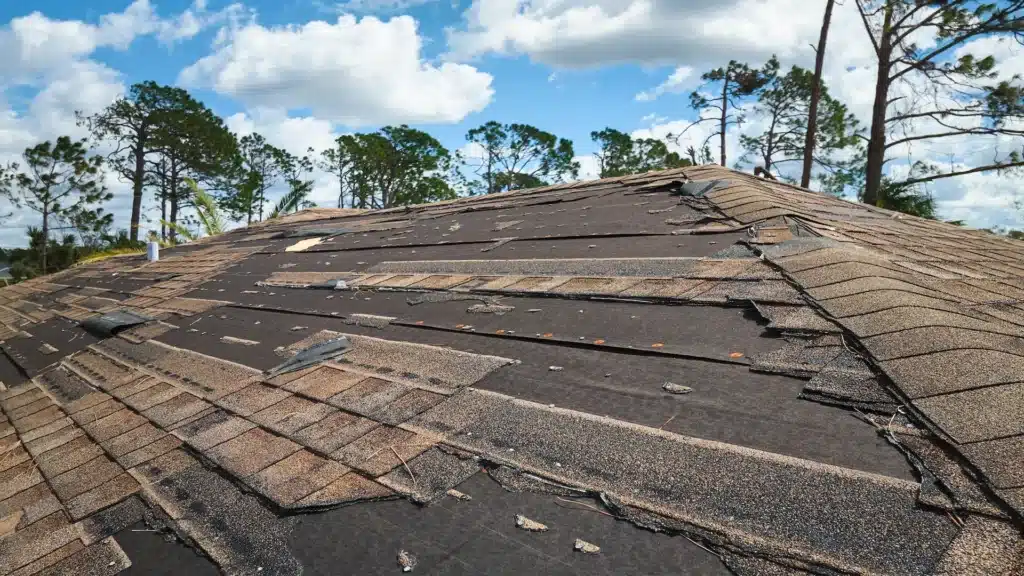
Honest Roofing provides emergency and storm damage roof repair across Pennsylvania, including hail damage, wind damage, and the insurance documentation that goes with it.
If water is coming in right now, call us. Do not wait for the rain to stop.
If nothing is actively leaking and you are simply trying to work out whether the storm did anything, read on. The reason most homeowners cannot tell is that the damage that matters most is not visible from the ground. Hail bruising leaves no hole and often no mark you can see at a distance. Wind damage frequently means a shingle whose seal has broken while the shingle itself stays flat. Both will leak eventually. Neither looks like anything from the driveway.
Table of Contents
What should you do right now, and how do you know if you have storm damage?
If water is actively coming in, contain it and protect the interior first: move furniture and electronics clear, place a bucket under any drip, and if the ceiling is bulging, pierce it at the lowest point to drain it in a controlled way. If nothing is leaking, check the ground level indicators instead: granules in the gutters, dents on metal surfaces, shingle debris in the yard, and damage to siding or screens on the storm facing side of the house.
If water is coming in: contain it first
Move furniture, electronics, and anything absorbent out of the way. Bucket under the drip, plastic sheeting or towels underneath to catch the spread.
One trick worth knowing: tie a length of string from the drip point into the bucket. The water runs down the string instead of splashing.
If the ceiling is bulging, drain it deliberately
This feels wrong and it is the most important thing on this page.
A ceiling holding water will fail, and it fails all at once. Pierce it at the lowest point of the bulge with a screwdriver, container underneath, and let it out in a controlled way. You get a small hole to patch instead of a collapsed section across your floor.
Photograph everything before you clean up
If there is an insurance element, pre-cleanup photos are your baseline evidence. Take more than you think you need, including wide shots that establish location.
If nothing is leaking: check your gutters for granules
The most reliable thing you can check yourself. Granules are the protective mineral surface on asphalt shingles, and hail knocks them loose. They wash into the gutters and pile up at the downspout outlet.
Some loss is normal on an older roof. A sudden accumulation after a storm is not. And those granules are what shield the shingle from UV, so losing them shortens its life even where nothing is leaking.
Look for dents on metal, not on shingles
Here is the trick. Hail that dents a gutter, a vent cap, flashing, or your air conditioning condenser hit the roof with the same force. Metal shows impact clearly where asphalt hides it.
Go look at the AC unit. It is at ground level, it takes a minute, and it is the most commonly missed evidence that hail actually fell at your address.
Walk the perimeter and check the storm facing side
Shingle fragments, tabs, or ridge cap pieces in the yard point to wind damage. Dented siding, torn screens, or a battered fence on one elevation indicate directional impact and tell a roofer where to focus.
No debris does not mean no damage. Wind often breaks the seal without moving the shingle at all.
Why you still need the roof inspected
Ground level signs confirm an impact happened. They cannot establish extent, and extent is what determines whether a claim is worth filing.
Hail bruising in particular is often only identifiable by touch, by feeling a soft spot where the mat has fractured beneath the surface. That takes someone on the roof. We inspect and document first, then tell you whether there is anything worth claiming.
What does hail damage look like, and how is it different from wind damage?
Hail damage on an asphalt roof appears as random circular bruises with granule loss at the centre, often soft to the touch where the mat beneath has fractured, scattered with no directional pattern. Wind damage appears as creased, lifted, torn, or missing shingles, usually concentrated along rakes, ridges, and eaves where uplift is strongest, and follows a clear directional pattern. Hail is random and often invisible at a distance. Wind is directional and usually visible once you know which edge to look at.
What hail damage actually looks like
Circular marks, roughly a quarter inch to an inch and a half across depending on stone size. Granules knocked away at the impact point, exposing the darker mat underneath.
The distribution is random, and that is the identifier. Wear and manufacturing defects produce patterns. Hail does not.
The mark may also feel soft or spongy where the mat has fractured without breaking through. That is a bruise, it is real damage, and that shingle will fail years earlier than the ones around it even though nothing is leaking today.
Why hail damage matters even when nothing is leaking
The part most homeowners are never told.
A bruised shingle has lost its UV protection and has a fractured mat underneath. It keeps working for a while, then fails early, often years after the storm and well after any claim deadline has closed.
That is exactly why insurers cover hail damage that is not leaking, and why waiting for a leak costs people their claim.
What wind damage actually looks like
Creasing across a shingle where it folded back and returned, leaving a horizontal line that permanently weakens it. Lifted tabs where the seal has broken. Torn or missing shingles. Displaced ridge cap.
It concentrates along rakes, ridges, and eaves where uplift is strongest, and follows the storm’s direction across the roof.
The wind damage nobody sees: broken seals
The most under-reported form of storm damage.
Asphalt shingles seal to each other with an adhesive strip. Wind can break that seal while the shingle stays flat and looks completely normal. It is now loose, it will lift in the next wind event, and it will eventually leak.
Invisible from the ground, and frequently invisible from the roof too without lifting tabs by hand. Any inspection that skips that step is not really an inspection.
What Pennsylvania storms actually do
We see fewer catastrophic hail events than the plains states, but we get regular summer thunderstorms with marginal hail and strong straight-line winds, plus nor’easters bringing sustained wind and wind-driven rain.
The pattern here is cumulative rather than catastrophic. Damage builds across seasons and goes unnoticed until something fails. The NOAA storm events database records hail and wind events by date and county, which is genuinely useful for confirming a storm hit your area on a given date. Over time that accumulated damage becomes roof leaks and premature shingle failure.
What does insurance cover, and how do you choose the right contractor?
Homeowners insurance generally covers sudden accidental damage from a storm, including hail impact and wind damage, subject to your deductible. It generally does not cover age, wear, deferred maintenance, or gradual deterioration. Most policies require a claim within a defined period after the loss, commonly one year in Pennsylvania though it varies by carrier, which is why damage discovered the following spring can fall outside the window even when it is genuine.
What is typically covered
Sudden accidental damage from a covered peril: hail impact, wind damage, falling limbs.
The key point is that coverage attaches to the damage event, not to whether the roof is leaking. This is what most homeowners get wrong, and it is why non-leaking hail damage is claimable.
What is typically not covered
Age, wear, deferred maintenance, gradual deterioration, pre-existing damage.
Also worth knowing: a roof near the end of life may be heavily depreciated in a settlement. Some policies pay actual cash value, which accounts for depreciation, rather than replacement cost, which does not. Same damage, very different check. Most people find out which they have only when they claim.
The deadline, and why it catches people out
Commonly one year, but it varies by carrier and policy wording, so check yours rather than relying on a general figure.
The real risk is simpler than the number. Damage found late is damage found outside the window, and homeowners who wait for a leak often find the leak arrives after the claim period has closed.
Should you file if you are not sure?
A denied or withdrawn claim can show on your claims history, so filing speculatively is not free.
Get the roof inspected and documented first, then decide based on whether the damage plausibly exceeds your deductible. Any contractor telling you to file before anyone has been on the roof is generating work, not advising you.
How to tell a real local roofer from a storm chaser
Every storm-affected neighbourhood gets door knocked, so this matters.
A legitimate contractor has a verifiable local address and work in the area predating the storm, carries Pennsylvania Home Improvement Contractor registration and liability insurance available on request, and provides written scope and inspection documentation before asking for any signature. Ask for the registration number, which you can verify through the Pennsylvania Attorney General’s office.
Never sign on the doorstep. Contingency agreements presented as “just authorising the inspection” frequently bind you to that contractor if the claim is approved.
And be wary of anyone offering to cover your deductible. That is widely treated as insurance fraud, it can expose you as well as them, and it tells you how that company operates generally.
Get It Looked At Before the Window Closes
The damage that matters is the damage you cannot see from the ground, which is why your own look around the yard was never going to settle it.
An inspection costs nothing to arrange. If there is no damage, you have lost an hour. If there is, you have found it while you still have a claim window open.
Contact Honest Roofing for a storm damage inspection anywhere in Pennsylvania. For active water intrusion, call rather than fill in a form.