
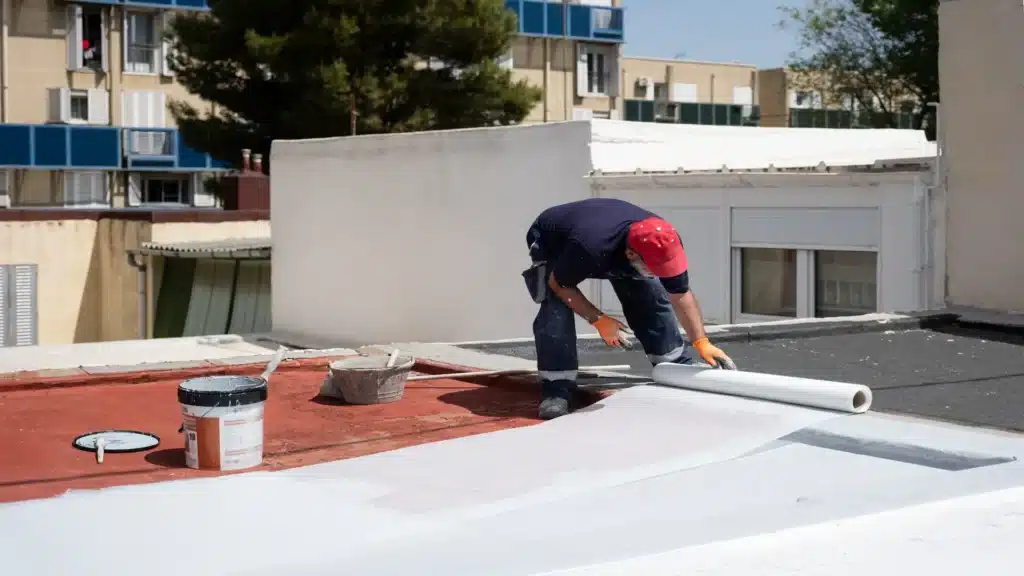
Honest Roofing installs TPO, EPDM, and modified bitumen flat and low slope roof systems for commercial and residential buildings across Pennsylvania.
If you are holding a flat roof quote with one of those acronyms on it and nobody explained why that system was chosen over the others, you are where most building owners find themselves. The three systems are genuinely different, they fail in different ways, and the one that suits a warehouse with kitchen exhaust is not the one that suits an office building with a clean roof and good drainage.
Most quotes specify a system without explaining the choice, and most owners sign without pushing back because asking feels like admitting you do not know. The choice matters. It affects how long the roof lasts and where it eventually fails.
Table of Contents
What are the main flat roof systems, and what is a TPO roof exactly?
A TPO roof is a single layer of thermoplastic polyolefin membrane, a white flexible plastic sheet, rolled out across the roof deck and heat welded at the seams to form a continuous waterproof surface. EPDM is ethylene propylene diene monomer, a black synthetic rubber membrane installed the same way but with seams joined by adhesive tape rather than heat. Modified bitumen is an asphalt based sheet applied in layers, torch applied or self adhered, and is the closest modern equivalent to traditional built up roofing. All three are installed over insulation on the roof deck.
What is a TPO roof?
TPO stands for thermoplastic polyolefin, which you do not need to remember. What matters is what it physically is: a white flexible plastic sheet, supplied in wide rolls, laid over insulation on the deck and welded at the overlaps with a hot air gun so the seams fuse into one continuous piece of material.
Thermoplastic simply means it softens with heat and hardens again as it cools. That property is what makes heat welding possible, and the welded seam is the main reason TPO has taken so much of the commercial market.
The white surface is standard rather than a style choice. The reflectivity does real work, which the next section covers.
What is an EPDM roof?
EPDM stands for ethylene propylene diene monomer. Also not worth memorising.
Physically it is a synthetic rubber membrane, almost always black, supplied in large sheets and installed over insulation the same way TPO is. The critical difference is the seam: EPDM seams are joined with adhesive tape or glue rather than welded.
EPDM also has the longest track record of the three in North America by a considerable margin, which matters if you value proven performance over newer technology.
What is modified bitumen?
An asphalt based sheet reinforced with polyester or fibreglass, applied in two or more layers. Installed either torch applied, where the layers are melted together with an open flame, or self adhered.
It is the direct descendant of traditional tar and gravel built up roofing. Its advantage is physical toughness and the redundancy of multiple layers, which matters on roofs people walk on regularly.
What sits underneath all of them
This is the part almost never explained to owners, and it matters more than the membrane choice.
The membrane is the visible waterproofing layer. Underneath it sits insulation board, which provides thermal performance and, on many flat roofs, the actual slope through tapered boards. Under that is the structural deck.
When a flat roof quote comes in noticeably cheap, the saving is usually in the insulation specification or in reusing existing insulation that may already be wet. You cannot see either once the membrane is down. Ask about it before you sign, not after.
How do TPO, EPDM, and modified bitumen actually differ?
The practical differences are seam method, reflectivity, chemical resistance, and repairability. TPO seams are heat welded, producing a seam as strong as the membrane itself, and the white surface reflects heat and reduces cooling load. EPDM seams are adhered rather than welded, which makes them the most common failure point, but EPDM resists UV exposure and weathering exceptionally well and is straightforward to repair. Modified bitumen offers multi layer redundancy and the best resistance to foot traffic damage, but absorbs heat and typically has the shortest service life of the three.
Seam method, and why it decides where a flat roof fails
Most flat roof leaks begin at seams. So how the seams are made determines where and when the roof fails, which makes this the most consequential difference between the systems and the one nobody explains.
TPO seams are hot air welded, fusing the two sheets into a single piece. A properly welded TPO seam is as strong as the membrane itself.
EPDM seams rely on adhesive tape. Effective, but it is a bonded joint rather than a fused one, and the adhesive degrades faster than the rubber around it. That is why EPDM roofs frequently need seam maintenance while the field of the roof remains in good condition. If you want to understand how that progresses into an actual leak, the mechanics are covered in our roof leak repair guide.
Reflectivity and what it costs you in summer
TPO is white and reflects most solar radiation. EPDM is black and absorbs it, reaching surface temperatures on a Pennsylvania July afternoon that surprise people who have never stood on one.
On a building with rooftop air conditioning or a conditioned top floor, that difference shows up on the energy bill. On an unconditioned warehouse it matters considerably less. The NRCA publishes technical guidance on low slope membrane performance if you want the detail behind it.
Worth being straight about this: it is a real factor for some buildings and close to irrelevant for others.
Chemical and grease resistance, the factor nobody asks about
Restaurant kitchen exhaust, vehicle maintenance facilities, and some manufacturing processes deposit grease and chemicals onto the roof surface.
EPDM degrades on contact with petroleum based substances. TPO handles them considerably better.
If your building has kitchen exhaust, this single factor can decide the system outright. Most owners are never asked about it during a quote, which tells you something about how carefully the system was selected.
Repairability and what happens in year twelve
EPDM is the easiest of the three to repair. Patches adhere readily and the material stays workable for decades.
TPO repairs require heat welding equipment and someone who knows the technique, which is worth considering if your original installer may not be around in ten years.
Modified bitumen repairs are straightforward but heavier work.
Service life, honestly compared
All three are heavily dependent on installation quality, insulation condition, drainage, and foot traffic far more than on the material itself.
A well installed system of any of the three will outlast a poorly installed system of the supposedly superior one. That is the honest framing, and it is why the questions at the end of this article matter more than the acronym on your quote.
Which flat roof system suits a Pennsylvania building?
TPO suits buildings with rooftop cooling equipment, conditioned top floors, or kitchen and chemical exhaust, because of its reflectivity and chemical resistance. EPDM suits buildings where UV exposure and long term weathering are the main concern, where the roof is unconditioned, and where ease of future repair matters. Modified bitumen suits roofs with regular foot traffic or rooftop equipment requiring frequent service access. On most Pennsylvania buildings the decision comes down to what is on the roof and what is underneath it.
Choose TPO when the building is conditioned or the roof gets contaminated
Offices, retail, medical buildings, anything with a conditioned top floor where summer heat gain reaches the bill. Restaurants and food service, where exhaust puts grease on the roof. Any commercial building where rooftop units make reflectivity worth having.
Choose EPDM when longevity and simple repair matter most
Unconditioned warehouses and storage buildings, where reflectivity delivers little benefit. Owners who want the longest proven track record available. Properties where in house maintenance staff will handle small repairs, since EPDM patching is the most accessible of the three.
The black surface means higher rooftop temperatures, which matters a great deal less on a building nobody is cooling.
Choose modified bitumen when the roof takes traffic
Roofs with regular service access, substantial rooftop equipment needing frequent maintenance, or any surface people walk on routinely. The multiple layers provide redundancy single ply membranes do not.
Also often the right answer on smaller residential flat sections where the flat roof ties into adjacent pitched roofing.
What Pennsylvania conditions mean for the choice
We cycle above and below freezing repeatedly through winter rather than staying frozen. That expansion and contraction stresses seams far more than a stable climate does.
Which makes seam quality more consequential here than in milder regions, and is a genuine argument for welded TPO seams on buildings where TPO otherwise fits.
Drainage matters just as much. Standing water that freezes stresses any membrane, and a system on a poorly drained roof will underperform regardless of what it is made of.
What to ask about the quote you are holding
Four questions, and the answers tell you more than the brand name on the proposal.
What membrane thickness, in mils? Thickness varies between products and affects both warranty tier and realistic service life.
Is the existing insulation being replaced or reused, and has anyone checked it for moisture?
Is the warranty a manufacturer system warranty or a contractor workmanship warranty? Those are very different documents with very different coverage.
How are the seams being made, and by whom? Welded seams require trained installers.
A contractor who answers all four clearly is a contractor worth considering.
Should you replace a flat roof or coat it?
If the membrane is intact but ageing and the insulation beneath is dry, a roof coating is usually the better financial decision and can add ten to twenty years for a fraction of replacement cost.
If the insulation is saturated or the membrane has failed across the field, replacement is the only real option. A coating over wet insulation seals the moisture in, the deck keeps deteriorating, and the coating fails early anyway.
The Building Chooses the System
Somebody handed you a quote with an acronym on it and moved straight to the number. The right system depends on what sits on your roof and what sits underneath it, and any contractor should be able to explain their choice in plain language.
Request a flat roof assessment from Honest Roofing for commercial or residential buildings anywhere in Pennsylvania.